
Why keep personal statistics?
In the previous post I described my process for creating a platform that lets me record and visualize personal statistics, such as how many free throws I hit, but I passed over the natural question of why bother to collect personal stats at all. I first read about the practice of treating one's life as a lab experiment in college, when I stumbled across Seth Roberts's blog. He took records of his daily activities to see what would improve his sleep, such as standing on one foot for a few minutes every day. I mentioned Seth in a column I wrote for the school paper, but other than that I didn't give his empirical practice much thought until a few years later when troubleshooting some health problems that had started, coincidentally, also while in college. At the time, I dismissed them as a problem with my glasses prescription. Only later did I learn that the headaches were actually cluster headaches.
Not much seems to be known about cluster headaches or what causes them, so the main advice I found was to keep a log of what I eat and any other potential triggers, like smoking or consuming alcohol, then reduce or eliminate the behaviors that precede episodes. For me, dairy is a trigger. But daily wasn't the only cause, because consuming cheese or yogurt only gave me one cluster headache, and sometimes without any dairy at all I would have cluster headaches for two or three weeks. Keeping track of everything I ate felt like a lot of work, and I doubted food was even the problem. For a while, I logged the headaches but no lifestyle factors. As the bouts worsened and lasted longer, I started collecting more data, such as when I ate, how big meals were, what vitamins I took, how long I spent driving (in case bright sunlight was a trigger), when I had sugar, whether I exercised. I recorded everything in a text-based system, then extracted data for ad hoc analysis.
Of everything I captured, I eventually identified two things that helped. The first I figured out about a year and a half into the COVID pandemic when a new round of headaches began. The previous bout had been almost twelve months before, instead of only six to nine months. Something in my lifestyle had changed. Thanks to my record-keeping, I had a chance to find out what made the difference.
I'd stopped exercising.
Getting back into a regular habit of light cardio didn't shorten the episode, but it did prevent the next episode from starting for 15 months. That one finding made 2022 a cluster-free year.
When that 15 months ended and a new bout came around for a visit, I was still exercising, but my log showed something else I'd stopped doing. During COVID, I'd started taking D3 supplements on a rumor that it boosted the immune system, but once COVID was no longer the menace it was then, I quit taking the supplements. Resuming the D3 supplements prevented cluster headaches for more than a year and a half, and when I did face another round, it was because I chose to test my tolerance for dairy.
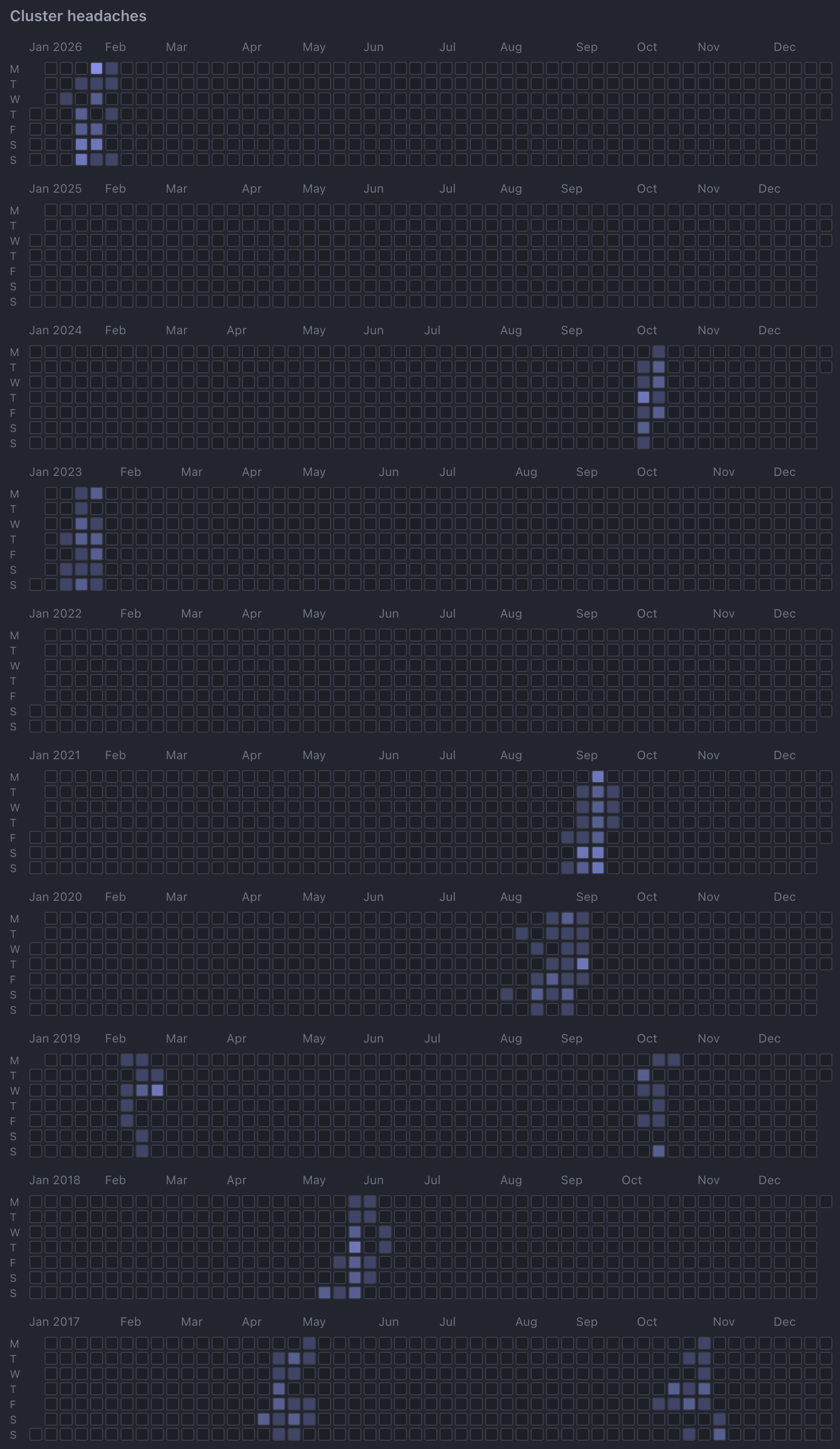
Adding in exercise and D3 and subtracting dairy seems to have solved my problem with cluster headaches, but cluster headaches vary from person to person, with different intensity, frequency, and triggers, so I don't know if what I did helps anyone else. What is more likely to help is keeping a log that you can easily mine for insights. I created Two Ravens to be the tool I wanted for capturing lifestyle factors and exploring the data. I may have addressed one problem, but there are a couple more I'd love to solve.
Keeping personal statistics gave me a resource to decode the worst part of my human experience, so if you've found benefit in keeping a lifestyle journal, I'd love to hear what you learned and how you went about it.