
5 Tips for Sketchnoting
Back in 2013 I learned about sketchnoting in a workshop at Midwest UX, and as someone who always doodled in my notes, giving meaning to the doodles felt like an obvious innovation I had overlooked, like putting wheels on luggage. After a few months' practice, I captured some brief tips. Since then, I've sketchnoted presentations from Agile Conf, local software meetups, company retreats, Clojure/conj, a handful of local one-day conferences, and a commencement speech. My style is mostly the same as it was ten years ago. And that's fine, because the point was never to get better at drawing, it was to capture notes more memorably. If you're interested in visual note-taking, here are five tips after 12 years and 100 sketchnotes.
1. Draw to create focus
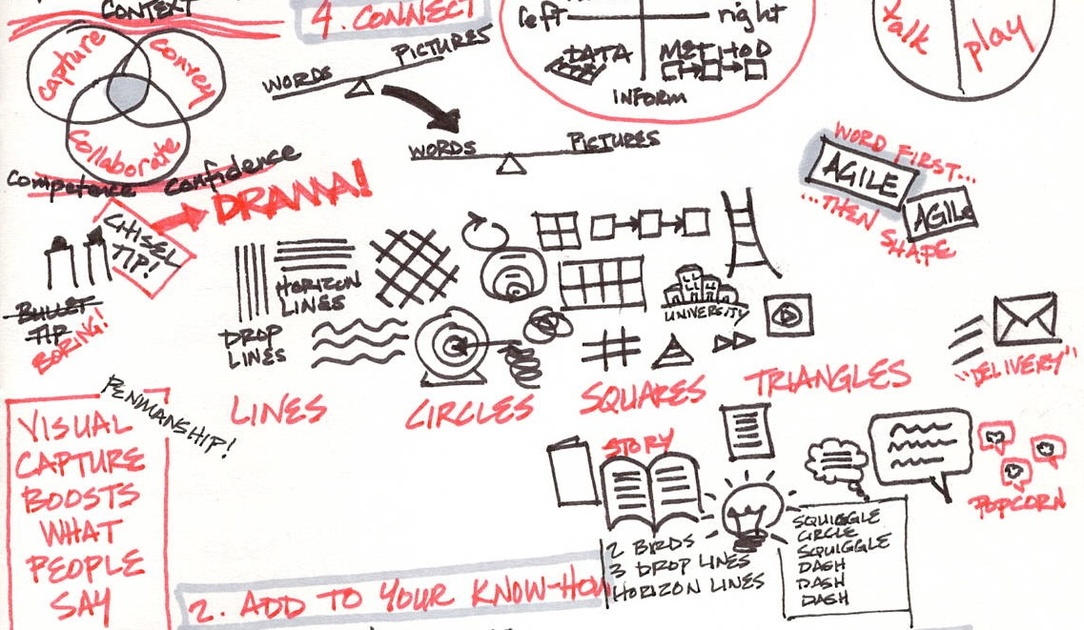
It's easy to get distracted during a 40-minute or longer talk, but drawing creates focus by distracting the part of the brain that generates distractions. Doodling occupies the hand and the brain's visual processing. Even abstract patterns can serve as memory anchors, but infusing your doodles with content from the presentation locks it even deeper into memory, and it's more fun.
You don't have to be an artist to make sketchnoting fun or memorable. Simple drawings are great. Elaborate illustrations often detract from focus, rather than enhancing it.
2. There are many ways to be visual
Sketchnotes frequently translate a presentation's visual elements into pictures, but many presentations are mostly text. Notes without a visual language can still be sketchnotes. Just capture text in visually interesting ways: make lists look like lists, underline important works, use an accent color for some words, write some words in ALL CAPS. Wrap sentences and fragments to leave room around them where you can write related concepts.
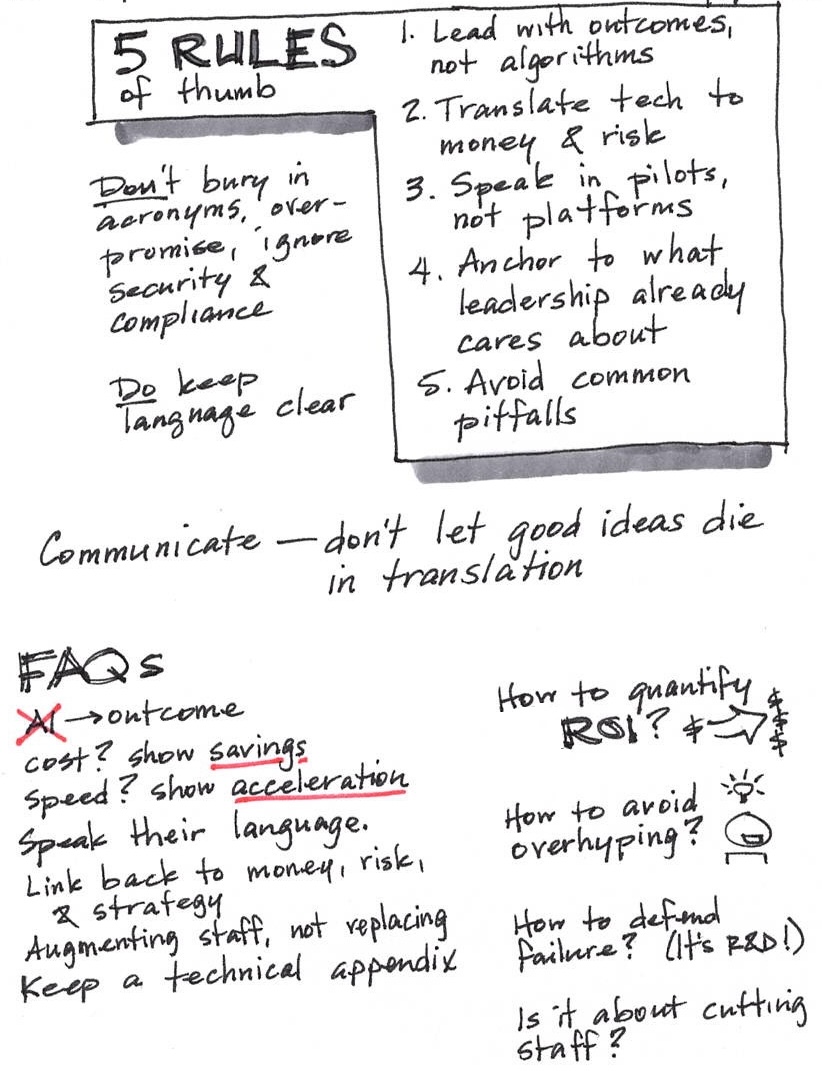
A presentation is given linearly, one word after another, but the ideas have non-linear relationships that benefit from being captured in two dimensions. Paper allows you to de-linearize the content, even if you don't draw any pictures.
3. Use pen and paper
Using physical pen and paper is freeing. I've sketchnoted on tablets, but switching pens and colors is distracting. If the app allows editing—which most do because of the imprecision of stylus input—then it's tempting to clean up a drawing instead of listening. Paper has no distracting notifications or apps, and the battery never dies. You might not be able to erase, but mistakes can be memorable too.
I take sketchnotes on an 8"x5" index card that's blank on both sides. For pens I use basic utensils: a Pilot V5 and an orange felt-tip Paper Mate. Both provide smooth lines. The one fancier tool I use is a Copic N4 marker with a brush tip, to add some color or shadow to drawings, though when it's used up I'll probably look for a lighter shade of gray.
4. Sketchnote for yourself, not others
Sketchnotes are never detailed enough to reconstruct a talk, so they tend to have little meaning to those outside the audience. Even for those who did hear the presentation, your personal notations are likely to be opaque. You might share your sketchnotes with the speaker or other members of the audience, but don't expect anyone to use them as a reference. They're for you. The act of making them is the valuable part. Your memory of the event will be embedded in your own physical movements of drawing and writing. Share your notes in recognition of the time and energy the speaker put into their talk, and as a token of the time the audience spent together, but no one will get more out of your notes than you do.
5. Do it!
You can start sketchnoting without experience, without tips, and without a grand reason. Do it for fun! Do it to enhance your memory of the occasion. Do it to create connection with others.
The purpose of sketchnoting isn't to become a master. You don't need artistic ability or perfect penmanship. The goal is to focus your attention, make you think more deeply about others' ideas, and have and share a memorable experience.
Sketchnoting is a gift to your future self.
(For concrete tips on sketchnoting, see my earlier post and Mike Rohde's The Sketchnote Handbook.)